高三最后300天 lets you write the week. It does not finish the week.
PREVIEW · Official Steam listing and the planner screenshot · Not played · Sources checked Oct 9, 2026. Our method.
高三最后300天 starts with the exam 300 days away. The listing has you choose a gender, a physics or history track, and a boarding or commuting life. Boarding brings lights-out, washing up and room checks. The commute ends on a last bus, and then a choice between the unfinished paper and sleep. Each week you name a direction and the subject you most want to strengthen. The page says the plan does not become stats. It changes which chances are easier to meet. The subjects those chances land on are named. Chinese, math and English, plus three electives on the physics track or the history track. Each has mastery, stability, weak points and an exam performance. Monthly exams, the first mock, the second mock and the three-day gaokao check more than the number. The page says review method, schedule, the state you are in that day and pressure already accumulated all affect the result. A high score is described as important, and as not the only measure of whether the year was worth it.
The change that counts is still the day: correct a wrong problem, join a discussion, keep a promise, protect sleep, or give the hour to someone nearby. An unfinished plan, a broken promise and a sentence you did not say stay in later scenes. Classmates are built from those scenes. Someone was your deskmate. Someone still waits at the gate after the class change. Someone is just the ordinary student in the back row who keeps answering. Friendship, competition, trust, distance and liking come out of the interactions. Romance continues only when the relationship is actually established. Choosing friendship, the page says, has its own complete story. Giving the hour to a person nearby is one of the choices the written plan cannot make for you.
The story is ten chapters and 303 narrative days. It runs from the start of the year through a seat change, the return from winter break, the hundred-day pledge, the graduation photo, the last class and the three exam days. Afterward you check the score, file your choices and see the admission, in an ending the page says is made of schoolwork, family, relationships and the choices themselves. Morning reading still starts a little past six. Evening study runs toward midnight. The unfinished paper on the desk is the listing’s picture of the room you plan inside.
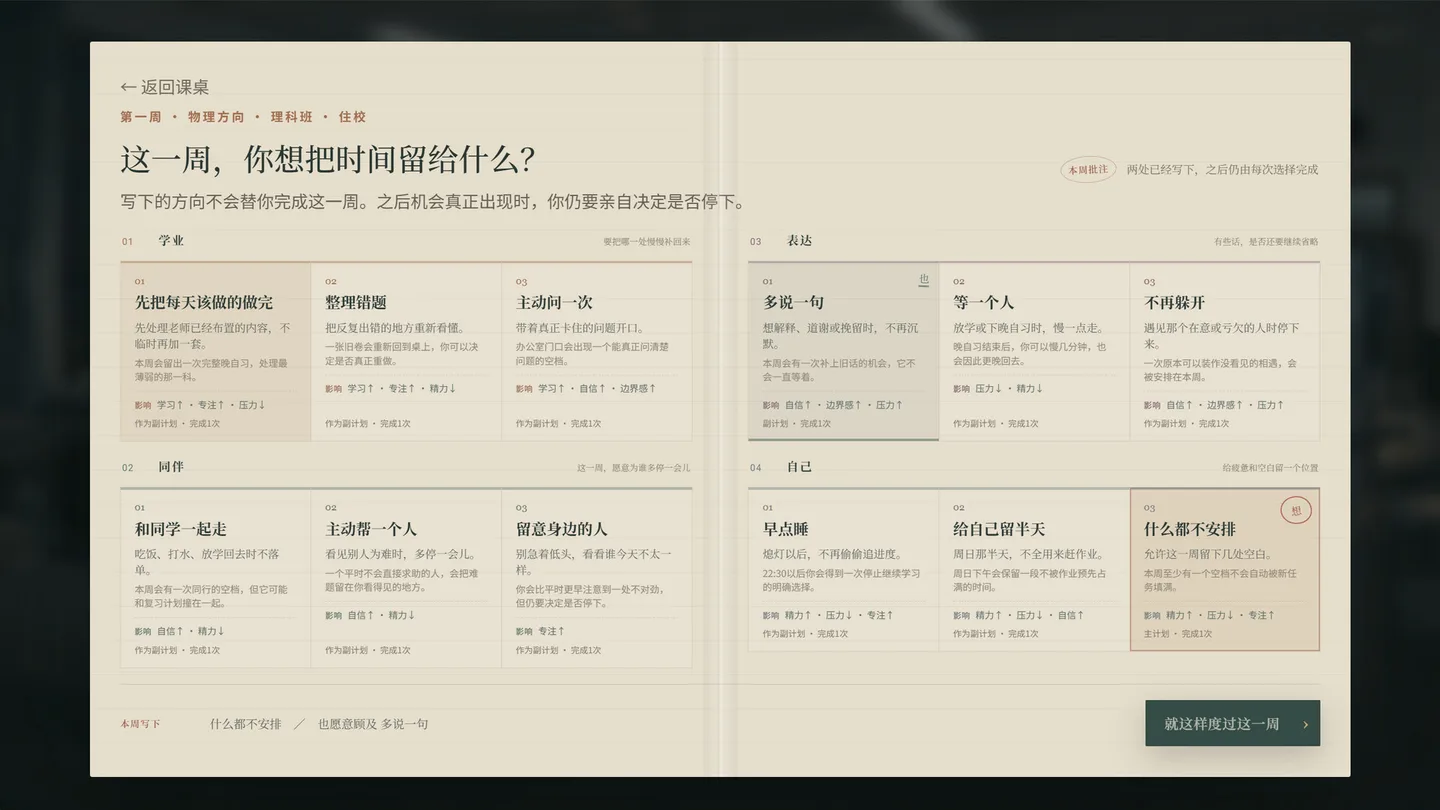
The supplied planner says the limit in larger type. The header reads week one, physics track, science class, boarding. The question asks what you want to leave the time for. Under it, the page says writing the direction will not finish the week. When the chance actually appears, you still decide whether to stop. A note says two lines are already written, and that each later choice is still completed by hand.
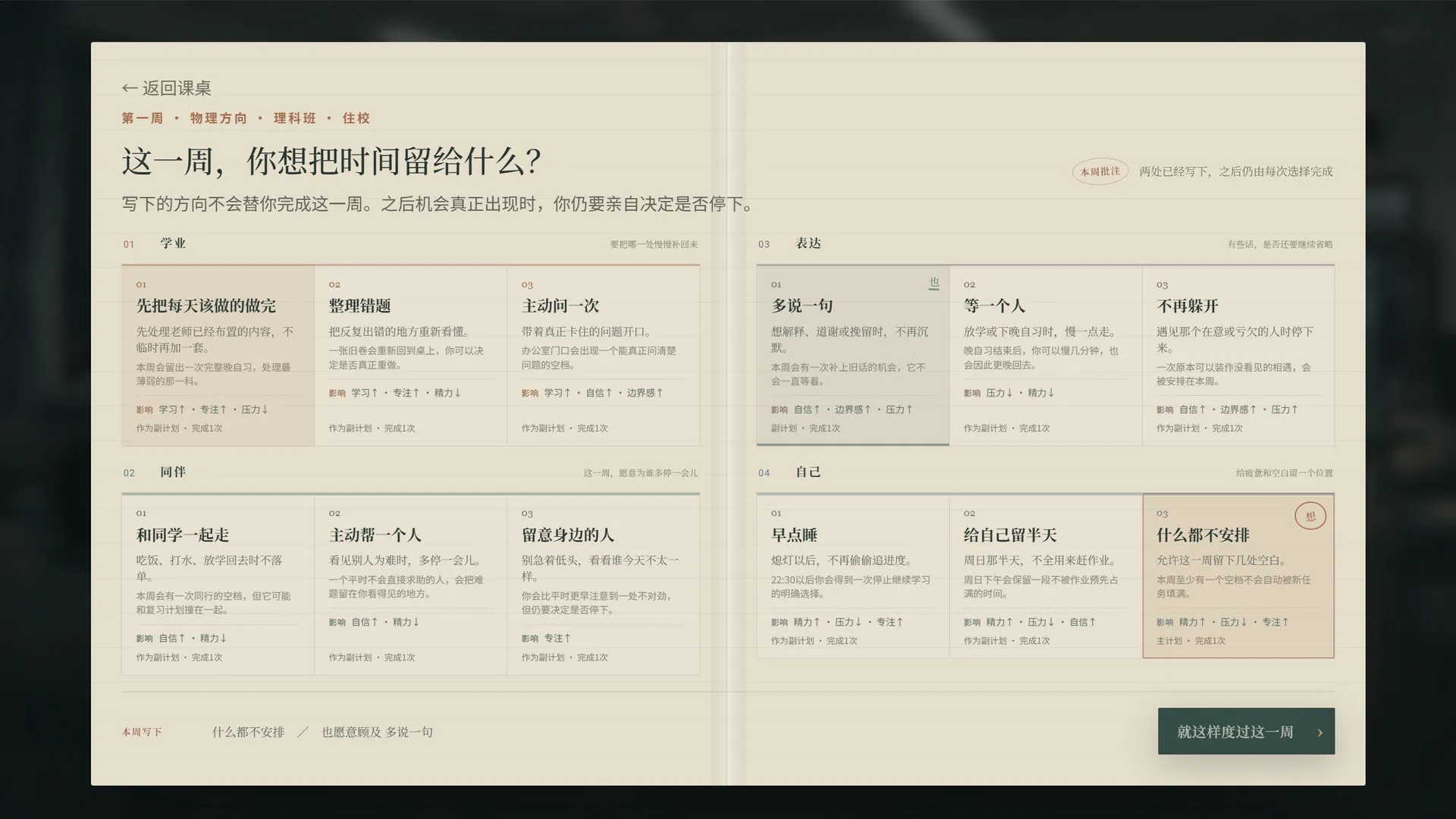
Finish a run and the listing lets you return to the 300-day mark. You cannot keep every answer. A few moments leave a trace. The plan is a bet on which chance shows up. The screenshot’s own sentence is that you still have to take it.
Sources & context
Store page rechecked October 9. The 300-day start, the track choices, the six subjects, the exam rules, the ten chapters, the 303 narrative days, the plan that does not become stats, and the return with partial memory are the listing's. The rule sentence under the planner's question is visible in the screenshot, so that sentence is evidence. Smaller card stories are not quoted as outcomes. No player reviews were used.
- Official Steam listing and screenshots Checked Oct 9, 2026
One mechanic, the decision it creates, and a little dry humor.